The Capital in Capital Punishment: Why the Death Penalty Should Not Be Reinstated in Canada
By Caleb B. - September 27, 2023
Why have this discussion?
The discussion of the death penalty is a highly emotional topic for many. It is a very strong form of Retributive Justice. It is important to have this conversation, because the cost of Capital Execution far outweighs the rewards. Despite this, surveys have shown that 51% of Canadians are in favor of reinstating the death penalty.1 On top of this, a majority of the world lives in places where Capital Execution is legal, such as China, India, and the United States.2
Capital Execution is a long and expensive process due to the amount of investigation that ought to be carried out to ensure that the right person is being executed. The average amount of time a prisoner spends on death row in the United States is 227 months, or about 19 years as of 2020.3 Some common arguments to reduce the cost is to spend less time investigating and just execute people faster, and it seems logical, because how common could a false death row conviction be? It would turn out, it’s quite common. Let’s take a look through some false convictions who were sentenced to death.
False Convictions
There are several previous cases of false convictions, as well as several cases of false convicts being sentenced to death. To ensure that this does not happen, lengthy waiting periods would be needed, and the financial cost of constant investigations would be more than just keeping the convict in prison for a life sentence. Since 1973, there have been over 190 exonerations of death row convicts,4 and more who were proven innocent after their death. To understand how and why these happen, and why we should not implement Capital Execution because of them, here are a few cases of wrongful death row convictions and executions.
Brenton Butler Case
In May of 2000, two tourists from Georgia got mugged while they were outside their motel. The mugger ended up shooting Mary Ann Stephens in front of her husband, and fled the scene.5 During the police’s investigation, they picked up Brenton Butler, a 15 year old student of a nearby high school. Butler was shown to the victim’s husband, whom he wrongly identified as the killer.5 The phenomena of false identifications by witnesses are quite common, according to the California Innocence Project, as many as 1/4 stranger eyewitness accounts are incorrect.6 Police brought Butler in for questioning, where he would admit to the crime orally and in writing in front of detectives.5 The case seemed air tight, if there would be a case in which you would use capital punishment, it would be this one, right? Well, according to Butler’s testimony during the trial, the two detectives involved in the interrogation, as well as the son of the Sheriff had intimidated and physically abused him into falsely confessing. During cross-examination, the police admitted that they had not searched for any of the stolen items, they had not gotten a search warrant for Butler’s house, and they had not asked Butler’s family of his whereabouts at the time of the murder.7 The jury found Butler not guilty within an hour of deliberation.5
A case of a tourist being shot outside their motel is not the greatest look for tourism for your town, which could have given the police motivation to try and solve the case as quickly as possible. When they picked up 15 year old Butler, they were able to manipulate him into falsely confessing for a crime. This case is a good example of a reason why a part of the criminal justice system would have motivation to falsely imprison somebody they know is innocent.
Nathaniel Woods Case
Nathaniel Woods was convicted in Alabama in 2005, and was executed in 2020 after a non-unanimous jury sentencing recommendation.8 He allegedly killed three Alabama police officers. It was acknowledged that Kerry Spencer, a co-defendant in the Woods case, shot the officers to death in a drug house.8 Spencer repeatedly stated that he shot the officers in self-defense, after they allegedly started assaulting Woods, and that Woods had no involvement in the shooting.8 Knowing that Woods was not the shooter, he was offered a 20-25 year plea deal, which he declined after misinformed advice from his lawyers. The prosecutors later denied offering this plea deal.9 After the plea deal was declined, police used a testimony from Woods’ then girlfriend Marquita McClure, stating that Woods had premeditated the murders because of his hatred of police.9 She later backtracked on that, stating she “made that up” and that she told the cops what they wanted to hear. She alleged that the cops threatened to charge her with parole violations if she did not testify against him.9 Woods was executed on March 5, 2020 on 4 counts of capital murder.10 Spencer still maintains that woods was innocent.
The Woods case is an example of a muddy water case where the death penalty was used. It is likely that Woods was innocent, but there is no way to tell for sure. The use of the death penalty in this case has been likened to a modern day lynching. Woods, a black man, was put to death non-unanimously by a majority white jury11 for killing three white police officers without pulling the trigger of the gun that killed them. Woods lost his right to life for being an accomplice to a crime, a crime in which the perpetrator has repeatedly maintained Woods’ lack of involvement in. There was plenty of pushback in the time leading up to Woods’ execution. The state maintained that he was guilty, and ultimately he was executed. Spencer is currently alive on death row.10
Should the state have the power to decide who has lost their right to life?
Timothy Evans Case
The most famous case of a wrongful execution was the Timothy Evans case. Evans was an alcoholic who was sometimes prone to violent outbursts, living in the Notting Hill district in London.12 He would go on to marry Beryl Thorley in 1947. Two years later, he went to the police told them that he had “disposed of his wife”, and when asked to elaborate, he stated “I have put her down the drain.”13 Evans had several confessions, the first of which being this one about the drain. He claimed that a man in a café gave him abortion pills for Beryl, and she had died after taking them. Upon investigation, the police could not find the Beryl’s body in the drain where he had said he hid it. The drain also required the strength of three officers to lift, making it near impossible that Evans would’ve been able to do it on his own.13 Upon being confronted on this, he gave a second story. He said that the man in the café never existed. He claimed Beryl was pregnant and that they were seeking an abortion due to them being unable to care for the child. Their downstairs neighbor, John Christie, offered to do the abortion for them. Despite Evans’ warnings, Thorley decided to go through with the procedure the next day. He claimed that Christie told him the abortion went wrong, and he witnessed Beryl lying dead on their bed. He claimed that Christie told him her death was due to septic poisoning. He claimed that Christie promised to get rid of the body while Evans was at work the next day, since abortions were illegal at the time, and he did not want the police to know about the procedure.13
On December 2nd, the police brought Evans to London while they searched his house. They found the bodies of Beryl and Geraldine Evans (their daughter). There was no evidence that an abortion had been performed, they were killed by strangulation.13 Evans then claimed that they had gotten into an argument over money and he strangled her with a piece of rope, and then strangled Geraldine the next night.13 He was arrested after that.
After his arrest, he retracted all of his previous claims and maintained that Christie was the killer. The cops did not believe him. Christie was the star witness for the case.13 He claimed that he confessed because he believed that the cops would beat him up until he confessed, and didn’t want to bear the pain.12
You would think that Evans going to the police, giving several contradictory accounts of the murder of his wife and daughter, and then blaming his neighbor and saying he didn’t do it after he was arrested, most of the time he would be the killer, right? Well, as it would turn out, he was innocent. John Christie had murdered Beryl and Geraldine, because he was a serial killer. He had killed two people prior to Beryl and Geraldine, and went on to kill four more people after them.14 Timothy Evans was hanged on the 9th of March, 1950.14 Christie was caught after he moved out of his house in 1953, only for the tenants that moved in to find dead bodies hidden in the walls while installing a radio receiver.15 He confessed to the murder of Beryl Evans on April 27, 1953, and was put to death for his murders on July 15, 1953, by the same man who had hanged Evans.16
The police thought that they had the case all figured out when Evans had confessed to the crime three times. This, combined with Christie being a former police constable, lead to an incredibly lazy investigation, resulting in the innocent Evans’ death. The investigation was so lazy, that police missed shallowly buried remains of his previous victims in his garden, so shallow that a dog was able to dig up one of the skulls.17 There was also a femur propping up a fence, which was overlooked.18
This case sounds like something out of a novel, but it’s a real case that actually happened. The Timothy Evans case is a prime example of why it is not a good idea to execute people quickly. Quick, lazy investigations lead to inaccurate results, leading to the deaths of innocent people. The mishandling of this case lead to the deaths of four more people before Christie was eventually caught, which could’ve been faster if Evans’ testimonies were taken and Christie was properly investigated. This is the exact reason that capital punishment is so lengthy and expensive today, they really do not want to make a mistake, but it results in significantly more resources being used than if they were to keep the prisoner for a life sentence. On top of that, Christie was only arrested 3 years after Evans was executed. If more time had been taken to investigate, Evans would’ve been able to be freed from prison, but you can’t un-kill somebody.
Ineffective at Deterring Crime
Capital Execution seems like it would be good at deterring crime on the surface, but upon closer inspection it reveals that it could be a bad deterrent for crime, and at worst, encouraging crime. Imagine a criminal who is mugging two people. The criminal just shot one of the victims, and in this scenario, the punishment for murder is death. If the criminal knows that they are already going to be killed, what is stopping them from shooting the second victim, to eliminate a witness and potentially increase their chance of living? Another scenario would be if the punishment for robbery and murder were both the death penalty. What’s stopping a criminal who just committed a robbery from killing somebody who just witnessed them? Adding the death penalty as a punishment to more crimes will lead to more murders, since if somebody witnessed the crime, it would be better for the criminal to kill them so that they can’t testify, on account of being dead.
The Cost of Capital Punishment
A common argument in favor of the death penalty is that it would save taxpayer money. Why should the taxpayer let a murderer live the rest of their life in prison off their funds? It turns out, the death penalty is significantly less efficient on taxpayer funds than other methods of punishment, namely, life in prison.19 According to an article from The Guardian, each execution in California costed over $300 million.20 This is due to all the factors that ought to be investigated to ensure that no wrongful executions take place. As a comparison, the average annual cost to keep a convict in prison in California was $106,131 per year.21 If somebody was convicted for the rest of their life at age 20, it would only cost just over $6 million.
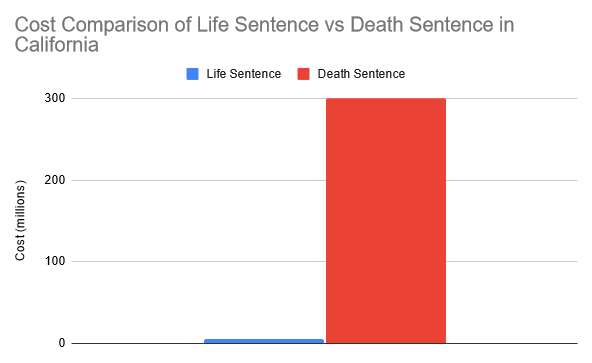
Apart from the financial cost, we have acknowledged that there have and will be false convictions. If you keep executing people, you’re eventually going to execute an innocent person. The cost of the death penalty is not only an absurd amount of money, but also innocent lives. According to the Death Penalty Information Center, since 1973, at least 190 people who were wrongfully convicted and sentenced to death were exonerated.4 A study showed that almost 70% of exonerated death row prisoners are results of perjury or false accusations, and official misconduct.22 For these reasons, Capital Execution ought not to be re-introduced into Canadian law.
Footnotes
-
Canseco, Mario. “Death Penalty Splits Views in Canada and the United States.” Research Co., 3 Mar. 2020, researchco.ca. ↩
-
“Countries with Death Penalty 2023.” World Population Review, worldpopulationreview.com. Accessed 21 Sept. 2023. ↩
-
“U.S. Capital Punishment - Average Time between Sentencing and Execution 2020.” Statista, Statista Research Department, 21 July 2023, statista.com. ↩
-
“Innocence.” Death Penalty Information Center, 18 Feb. 2021, deathpenaltyinfo.org. ↩ ↩2
-
Pinkham, Paul. “Butler Case Spotlights Interrogations.” The Florida Times Union, 22 Feb. 2001, archive.org. ↩ ↩2 ↩3 ↩4
-
“Eyewitness Identification Problems & Procedures.” California Innocence Project, California Innocence Project, californiainnocenceproject.org. Accessed 22 Sept. 2023. ↩
-
Writer, Times Staff. “Acquitted Man Is Witness at Retrial.” Tampa Bay Times, Tampa Bay Times, 12 Dec. 2019, tampabay.com. ↩
-
“Executed but Possibly Innocent.” Death Penalty Information Center, deathpenaltyinfo.org. Accessed 21 Sept. 2023. ↩ ↩2 ↩3
-
Rahman, Khaleda. “Alabama Man’s Execution for Cop Killings Will Be a ‘lynching,’ Family Say.” Newsweek, 5 Mar. 2020, newsweek.com. ↩ ↩2 ↩3
-
Barry, Dan, and Abby Ellin. “He Never Touched the Murder Weapon. Alabama Sentenced Him to Die.” The New York Times, The New York Times, 5 Dec. 2021, nytimes.com. ↩ ↩2
-
Urell, Aaryn. “Nathaniel Woods Execution Reveals Disturbing Bias in Alabama.” Equal Justice Initiative, 3 June 2022, eji.org. ↩
-
Taylor, Rupert. “Timothy Evans: Wrongfully Executed.” CrimeWire, 8 July 2023, thecrimewire.com. ↩ ↩2
-
Jacobson, Stephanie. “Crime of the Century: The Case of Timothy Evans.” HeinOnline Blog, 15 Oct. 2021, heinonline.org. ↩ ↩2 ↩3 ↩4 ↩5 ↩6
-
“The Murders at Rillington Place.” Watford Observer, watfordobserver.co.uk. Accessed 21 Sept. 2023. ↩ ↩2
-
Kennedy, Ten Rillington Place, p. 222. ↩
-
Marston, John Christie, p. 95. ↩
-
Real-Life Crimes Issue 11 p. 239. ↩
-
“Revisiting the Crimes and Home of One of Britain’s Worst Serial Killers.” The Independent, Independent Digital News and Media, 24 Nov. 2016, independent.co.uk. ↩
-
“Costs.” Death Penalty Information Center, 3 Feb. 2021, deathpenaltyinfo.org. ↩
-
“Death Penalty Costs California More than $300M per Execution.” The Guardian, Guardian News and Media, 20 June 2011, theguardian.com. ↩
-
“How Much Does It Cost to Incarcerate an Inmate?” Legislative Analyst’s Office, 2022, lao.ca.gov. ↩
-
“Innocence Resources.” Witness To Innocence, witnesstoinnocence.org. Accessed 21 Sept. 2023. ↩